

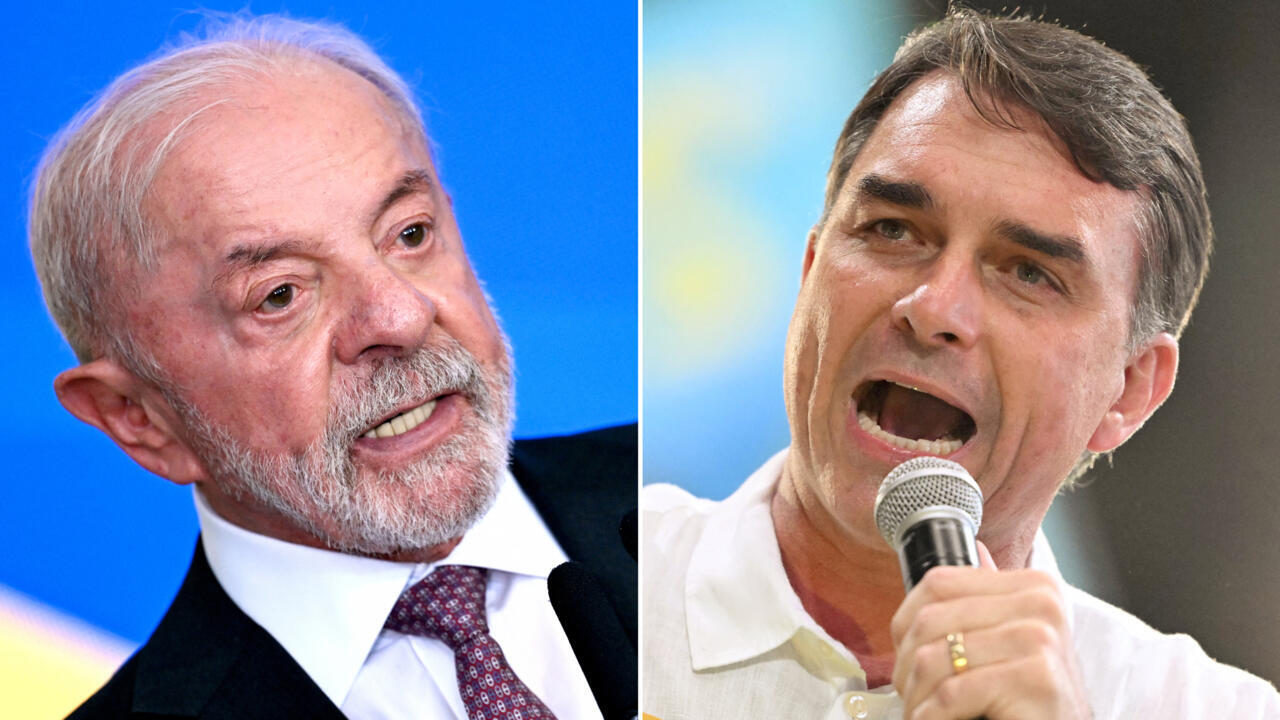
Brazilians voted Sunday in a high-stakes presidential election pitting incumbent Luiz Inácio Lula da Silva against Senator Flávio Bolsonaro amid a regional shift to the right. Bolsonaro is the son of jailed former president Jair Bolsonaro. A runoff will take place October 25 if no candidate wins an outright majority.
Brazilians voted Sunday in a high-stakes presidential election pitting incumbent Luiz Inácio Lula da Silva against Sen. Flávio Bolsonaro at a moment when the region is shifting to the right in line with the Trump administration.

Bolsonaro, 45, is the son of far-right former President Jair Bolsonaro who is serving a 27-year sentence for a coup attempt and an ally of US President Donald Trump. Lula, who at 80 is one of the world’s oldest heads of state, is running in his seventh presidential election and has strengthened Brazil's ties with Beijing.
Trump allies have fared well in recent elections in Latin America, including in Argentina, Colombia, Honduras and Peru.
If none of the 12 presidential candidates gets more than 50% of the vote, the top two will head to a runoff on Oct. 25 in Latin America’s economic powerhouse.
Brazil's nearly 159 million eligible voters will also elect 27 state governors, members of state legislatures, all 513 federal members of the lower house of congress and 54 of the country’s 81 senators in Sunday’s vote.
Polls closed at 5 p.m. Sunday with those still in line able to vote and tallies started rolling in within the hour. In the last presidential election, the two candidates who advanced out of the first round were mathematically determined at about 8 p.m. Brasilia time with nearly 99% of votes counted.
While the once widely popular Lula saw his approval ratings plummet during his third term, standing up to the US has given him a boost. And he still enjoys a strong base of supporters who credit his social policies for improving millions of Brazilians’ lives.
The incumbent president has often spoken about risks of US intervention in the Brazilian elections after the Trump administration imposed high tariffs against Brazilian exports, revoked the visa of the country’s ambassador and sanctioned a Supreme Court justice who chaired the investigation that eventually sentenced Jair Bolsonaro, Lula's predecessor.
Lula told journalists after voting Sunday that he needs “to do double of what we have done” if reelected, and expressed confidence in a first-round win.
But the incumbent faces a tough battle because of an affordability crisis and a corruption scandal that ensnared the same justice who led the investigation into Bolsonaro.
To display this content from YouTube, you must enable advertisement tracking and audience measurement.
One of your browser extensions seems to be blocking the video player from loading. To watch this content, you may need to disable it on this site.
“Many in the Lula campaign were not expecting such a difficult election a few weeks ago, and it is clear to them that the present election is a tough battle and the next ones, without Lula, could be even more so,” said Carlos Melo, a political science professor at Insper University in Sao Paulo.
Flávio Bolsonaro has touted his proximity to the White House, although he denies his campaign received help from the US government.
He has promised to crack down on Brazilian criminal groups and insisted that Brazil needs to strike better deals with the Trump administration, including in the rare minerals economy, second only to China. Bolsonaro also has campaigned on releasing his father and bringing him back to politics.
“Brazil needs change. Brazil can’t stand so much suffering,” he told reporters at the Rio de Janeiro voting center, where he cast his vote Sunday.
The senator faces his own challenges. He has seen his political career tainted by several corruption accusations, including receiving millions of dollars from a disgraced banker to allegedly produce a movie on his father’s life.
Rosane Wink, 67, a retired engineer, is a lifelong conservative voter who supports Bolsonaro and his promise to classify criminal groups as terrorist organizations.
“It’s a kind of terrorism that they’re doing with us,” said Wink as she voted in Rio de Janeiro. Last month she had a gun held to her stomach as a criminal bit her hand and removed her wedding ring, she said.
Maria Ribeiro, a 50-year-old cellphone vendor from Brasilia, said she voted for Bolsonaro because she wants freedom to express her Evangelical religion. She hopes he follows in his father's footsteps.
“I voted for his father, and I don't regret it,” she said.
The proximity to his father was what worried Lorena Zschaber, a 40-year-old photographer, who watched the results roll in at an LGBTQ+-friendly bar in downtown Rio de Janeiro. During his father’s presidency, “people felt more at ease to discriminate," she said.
"I’m an LGBTQ+ woman, I can’t think of anything worse happening than Flávio Bolsonaro being elected,” she added.
Rosângela Resende da Rocha, a 69-year-old who was previously a stay-at-home mom, said she supported Lula's social policies that help the “less fortunate” and how he stands up to Trump.
“That crazy guy wants to come in here to buy our country, so that our country will be like it is over there,” she said at a voting center in Brasilia. “He won’t succeed if Lula wins.”
Even for those outside the country, Lula's social programs, including his flagship welfare program Bolsa Familia, drove many to continue supporting him.
“Thank God I do not need (the help of) social programs, but I vote for those that need them: health, education, basic sanitation, housing, food," said Catia Oliveira, a 61-year-old Brazilian who cast her vote from Portugal.
Trump has made his opinions clear on recent Latin American elections, endorsing candidates in Colombia and Honduras. He has spoken out against former President Bolsonaro's conviction and declared Brazilian gangs to be foreign terrorist organisations, a move Lula opposes and Sen. Bolsonaro supports.
To display this content from YouTube, you must enable advertisement tracking and audience measurement.
One of your browser extensions seems to be blocking the video player from loading. To watch this content, you may need to disable it on this site.
Lula has repeatedly warned the US not to meddle in Brazil’s elections. His supporters wore shirts Sunday with messages denouncing US interventionism.
Retired Portuguese teacher Maria Lucia Gerson Alo wore a T-shirt that read “neither colony, nor backyard, sovereign Brazil" as she voted in Rio de Janeiro.
“We’re not a colony, that time is over,” Gerson Alo said. “Trump should look after his own country’s problems, we will look after ours.”
The Trump administration did not respond to a request for comment on whether it is seeking to interfere in the vote.
No significant fraud has ever been detected since Brazil adopted its electronic voting system in the 1990s.
The Organisation of American States' electoral observation mission reported Sunday that “the voting has been going smoothly and under adequate safety conditions.” Electoral authorities have assured that electronic votes are secure and verifiable.
“We are almost three hours away from the end of the voting and everything is proceeding normally and with the greatest possible transparency,” the president of the Superior Electoral Court, Kassio Nunes Marques, said Sunday afternoon, adding that there was “no concrete indication of international interference.”
Voters appeared largely confident that the country's voting system can't be tampered with.
Josemar Lauriano Pereira, a 46-year-old lawyer in Rio de Janeiro, said that the rapid availability of results helped combat fraud and uncertainty.
“When results take a lot of time, it creates an opening for people to cast doubt on the results, to say there’s been a problem,” he said.
Alex de Almeida Souza, a 49-year-old social project analyst in Brasilia, worried about international interference to influence public opinion on social media, but said he trusts the credibility of the Brazilian electoral system.
Originally reported by France 24.