

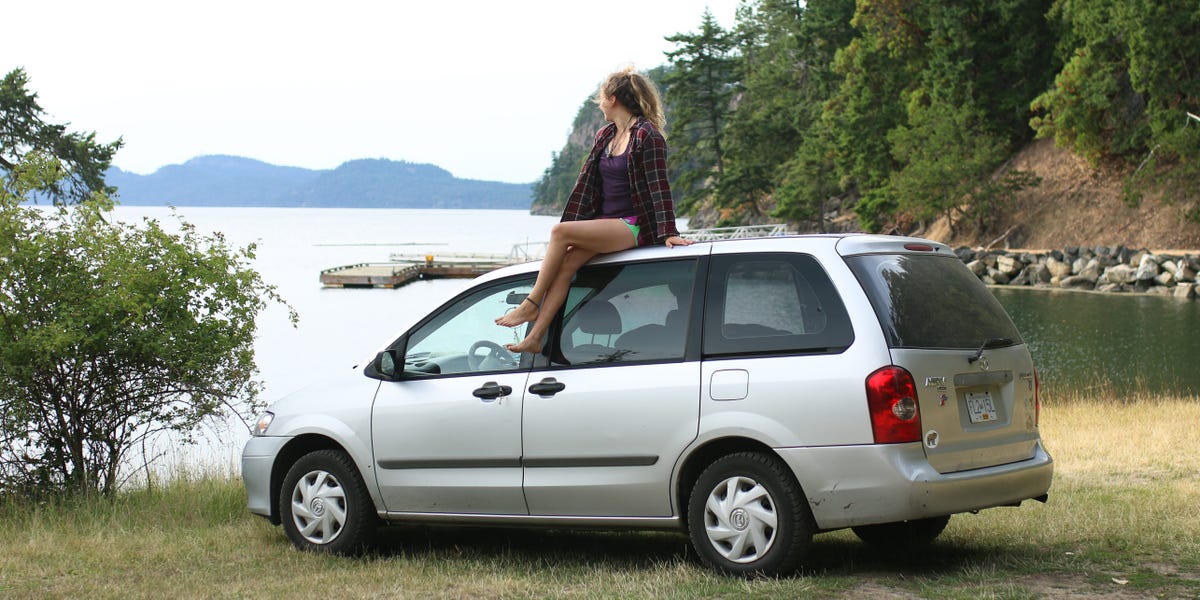
When I was a university student also working full-time, I had enough income to afford two out of the following three expenses: tuition, rent, or a vehicle.On-campus housing was pricey, and the idea of paying for someone else's mortgage didn't appeal to me. In the end, I decided I'd prefer having the freedom of a vehicle — and if I got the right one, it could also be a place to live.So, I bought a cheap minivan on Facebook Marketplace and converted it into my little home on wheels.Since I decided to buy a van on the heels of my previous car breaking down, my search was more rapid and desperate than I would recommend.A large, typical van-life vehicle, such as a Volkswagen Vanagon or Sprinter, was out of the question for me price-wise. Even used ones usually cost five figures.I bought the first semi-liveable van I found on Facebook Marketplace that test-drove reasonably well and had under 300,000 kilometers on the odometer.My 2005 Mazda MPV cost me about $1,000 Canadian dollars, or about $730, after I negotiated with the owner — the tires were completely worn down, and he was missing useful paperwork.
I tried a few different builds inside this typical seven-seater minivan, including nailing together a rickety bed with a two-by-four and a sheet of plywood.I eventually settled on a setup in which I took out all the seats except the drivers' and front passengers', and created a nest on the floor of the van using patio-seat cushions, pillows, and heaps of blankets.I stored my clothes in a duffel bag, kept a large cooler and a milk tote for my food, and had another big plastic bin for my camp kitchen supplies.I also made covers I could take on and off my windows using squares of reflective insulation sheets and Velcro.The minivan turned out to be the perfect vehicle to live in, as it blended in inconspicuously wherever I wanted to park it overnight.Some of my best parking spots include a quiet residential side street, a public recreation center parking lot, and the trailhead to a public park. A lot of the time, I ended up in a dark corner of my university's parking lot.I was only woken up by a security guard or the police for parking where I shouldn't have once or twice. Otherwise, I'm fortunate to have had few issues, and I generally felt safe living in my van.Over the years, I spent thousands of dollars on maintenance, repairs, and fuel for my van — but this was all still much cheaper than renting a place.I learned to take advantage of all on-campus amenities and really make the most of my tuition.In the mornings, I'd make coffee in a kitchen inside the student union building.

The athletics building had showers, and the library had quiet places to study. I searched every corner of campus for the most unused bathrooms I could brush my teeth in.I also had incredibly gracious friends who let me store extra groceries in their fridges and freezers and crash on their couches on unbearably cold nights.As for food, a lot of the time I meal-prepped large batches of soup at my mom's house on weekends, froze them in glass jars, and stored them in my camp cooler to eat throughout the week. To warm them up, I'd use one of the many microwaves scattered around campus buildings.I'd also stock up on fruit and simple food items that require little to no prep and are easy to store, like peanut butter, jelly, and bread for sandwiches; microwavable noodles; bagels and cream cheese; and boxed mac and cheese (paired with cut-up hot dogs, a true delicacy).In 2019, the living was easy, as I had so many public amenities and friends' houses freely available to me.However, when the coronavirus pandemic swept Canada in 2020, all my access to resources like friends' couches and communal showers seemed to disappear overnight.I was OK during the summer, as I'd cook my meals on my camp stove on a picnic table, bathe in the nearby lake, and use porta-potties in public parks.When November rolled around and the cold started to set in, I knew I couldn't survive a third winter in my van without easy access to indoor public spaces, so I rented a room close to my university from a very nice lady.By this point, I feel lucky I was able to afford doing so and that living in my vehicle was a choice, not a true necessity.
From there, my minivan became my commuter vehicle and served as a living space only during occasional camping trips until I had to scrap it.Living in my van for almost two years was certainly a struggle and a masterclass in resourcefulness, but I never regretted the time I spent in it, as I ended up not only graduating from university debt-free but also with some savings in the bank.These days, I'm living comfortably in a tiny apartment with my boyfriend and dog.I will never again take for granted the fact that I can use a toilet in the middle of the night, own a bookshelf with heaps of books, and have a space where I can entertain friends or offer hospitality to others.I've since bought another van — an even older one with a bed and totes of camping supplies in the back. It's large enough to go on road trips with my dog and boyfriend, but still reasonable enough to park in front of my apartment building.I'm fortunate to no longer be a broke student, but I'll never quite give up sleeping in my car.
Originally reported by Business Insider.