

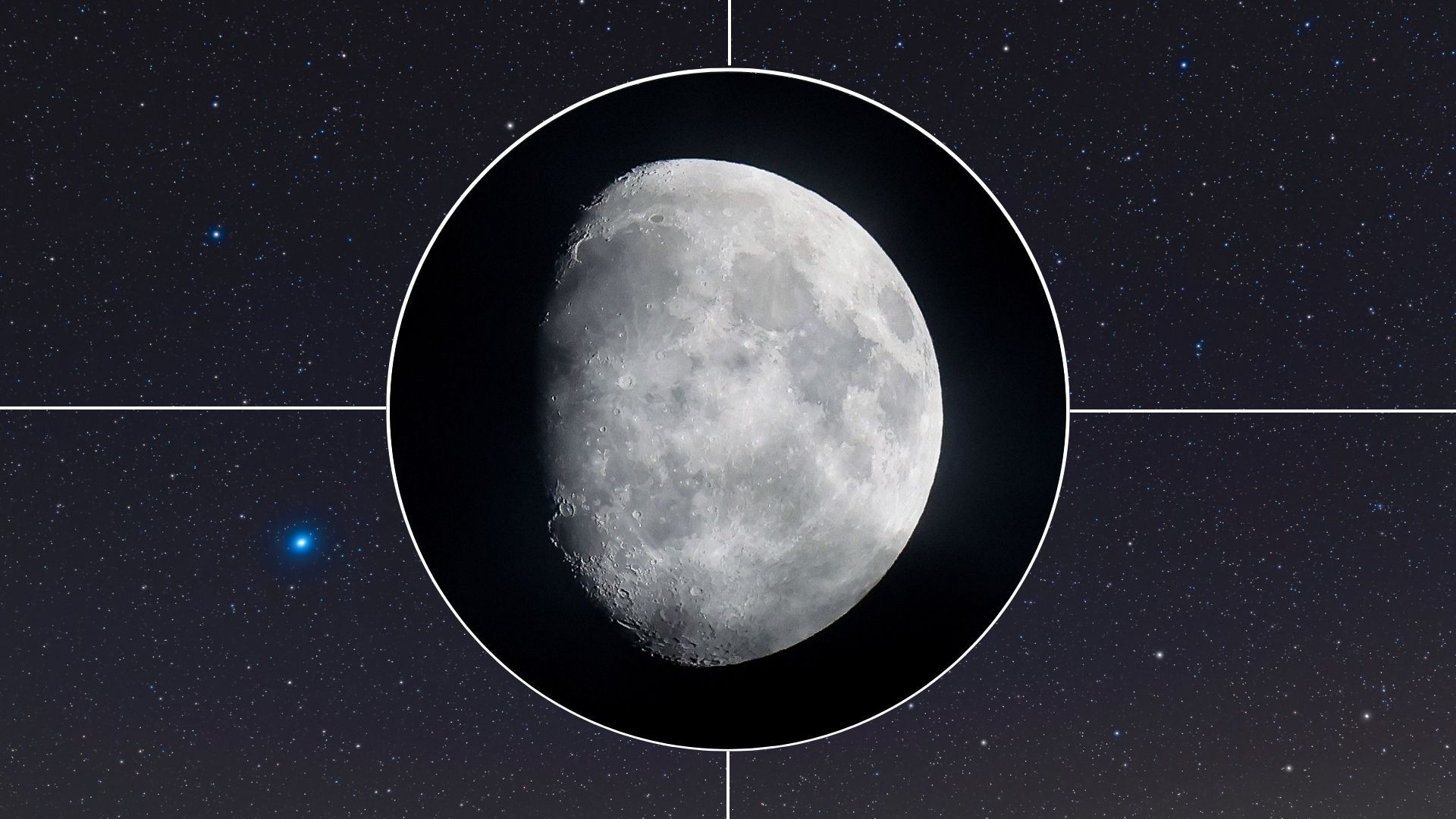
Look to the southern sky at sunset on May 26 to see the waxing gibbous moon shining close to the sparkling blue-white light of the bright star Spica in the constellation Virgo, ahead of this week's rare "Blue Moon".
The 83%-lit moon will sit a little under 40 degrees above the southern horizon — roughly the width of four clenched fists stacked at arm's length — with Spica close to its left.

Spica's light represents not one, but two colossal stars, which orbit each other once every four days. Together, they shine with a combined luminosity of more than 12,000 suns, according to the astronomy website EarthSky.
Turn a pair of binoculars or a small telescope on the moon to see an arc of light shining close to the line separating night from day on the lunar surface, created as sunlight glances off the peaks of the Montes Jura mountain range on the northwestern edge of Mare Imbrium.
This is a fantastic go-to telescope with a 4-inch aperture and can help you quickly find a steady view of the moon. For a closer look at craters and the terminator, make sure to grab a 9mm or 12mm eyepiece and get stronger magnification.
Then sweep your gaze towards the equator to spot the 58-mile-wide (93-kilometer) Copernicus Crater, surrounded by bright streaks of material blasted out during the violent impact that formed it. Finally, follow the shadowy night-day divide downward to find the approximate location of the south lunar pole, which could serve as a landing zone for the planned 2028 Artemis 4 moon mission.
You may notice the moon drifting slowly towards Spica throughout the night, before both objects set in the west in the early hours of May 27. By sunset on the following evening, the moon will have jumped to Spica's lower left as it continues on an orbital path that will see it meet the red supergiant Antares in the constellation Scorpio on May 31, as the second full moon of the month, known as a "Blue Moon", takes to the night sky.
Want to capture gorgeous photos of Earth's natural satellite? Then be sure to read our guide to photographing the moon, along with our roundups of the best cameras and lenses for astrophotography.
Anthony Wood joined Space.com in April 2025 after contributing articles to outlets including IGN, New Atlas and Gizmodo. He has a passion for the night sky, science, Hideo Kojima, and human space exploration, and can’t wait for the day when astronauts once again set foot on the moon.
Originally reported by Space.com.